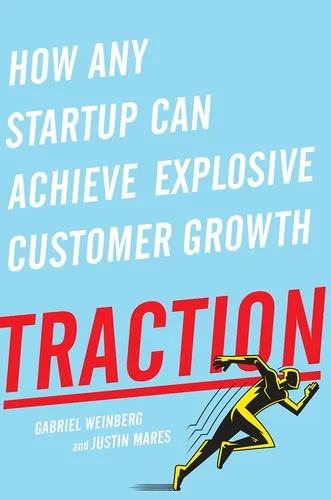
Traction by Gabriel Weinberg: the 19 channels, explained for 2026
My #1 book for founders. What Traction teaches, the Bullseye framework, all 19 traction channels in plain English — and what has changed or is missing in 2026, like AI search and short-form video.
By Shakir Sajad · 5 min read · Updated 2026-11-19
I've shipped 15+ products. The pattern I see again and again — in my own work and in founders I talk to — is the same one this book is about. We build for months, launch, and then wonder where the users are.
Traction fixes that way of thinking. It's short, practical, and it turns "marketing" from a vague fear into a list you can work through.
Who wrote it
Gabriel Weinberg founded DuckDuckGo, the private search engine. Justin Mares is a serial founder whose companies include Kettle & Fire.
Before writing, they interviewed more than 40 successful founders about how they actually got their customers. The book is built on those stories.
The big ideas
- Traction beats product. A great product with no distribution still dies. Getting customers is a skill, not luck.
- The 50% rule. Spend about half your time on traction — even before the product is done. Build and grow in parallel, not one after the other.
- Every channel is an option. Founders usually only consider the channels they already know. There are 19, and the one that works for you may be one you'd never think of.
- One channel at a time. Most companies that grow fast get most of their growth from one main channel. Find it and go deep.
- Channels wear out. What works today gets crowded tomorrow. You'll need to find the next one.
The Bullseye framework
This is the heart of the book: a simple loop for choosing a channel.
- Brainstorm. Write down at least one real idea for every one of the 19 channels. Don't skip the ones that feel wrong.
- Rank. Put each channel in an outer ring (possible), middle ring (promising) or inner ring (the best 3).
- Prioritize and test. Run small, cheap tests on your inner-ring channels. Ask: how much does a customer cost here, how many customers are there, and are they the right ones?
- Focus. When one channel clearly wins, put almost all your traction effort there.
Then repeat — every time growth slows, go back to step one.
The 19 traction channels (and how they look in 2026)
Here's every channel in plain English, with my take on how it has aged. Still works means the book's advice holds. Changed means the idea works but the tactics are different now.
| # | Channel | What it means | 2026 status |
|---|---|---|---|
| 1 | Viral marketing | Users bring in more users (invites, sharing) | Still works |
| 2 | Public relations (PR) | Getting covered by press and media | Changed — podcasts, newsletters and creators matter as much as press |
| 3 | Unconventional PR | Stunts and surprises that get attention | Still works — now often spreads on social first |
| 4 | Search engine marketing | Paying for ads on Google and Bing | Still works — more competitive and costlier |
| 5 | Social and display ads | Paid ads on social sites and websites | Changed — targeting is weaker after privacy rules |
| 6 | Offline ads | TV, radio, billboards, print | Still works — rarely right for an early startup |
| 7 | SEO | Ranking in search results for free | Changed — AI answers now sit above the links |
| 8 | Content marketing | Blogs, guides and resources that bring readers | Still works — quality and real experience matter more |
| 9 | Email marketing | Emails to leads and customers | Changed — stricter sender rules |
| 10 | Engineering as marketing | Free tools that bring in users | Still works — and AI makes them faster to build |
| 11 | Targeting blogs | Getting featured on niche blogs | Changed — the same idea now means newsletters, YouTubers and creators |
| 12 | Business development | Partnerships that help both sides | Still works |
| 13 | Sales | Talking to customers one by one | Still works |
| 14 | Affiliate programs | Paying people a share for each sale they send | Still works |
| 15 | Existing platforms | Growing on top of a bigger platform (app stores, marketplaces) | Still works — platforms changed |
| 16 | Trade shows | Meeting buyers at industry events | Still works |
| 17 | Offline events | Hosting your own meetups and events | Still works |
| 18 | Speaking engagements | Talks at conferences and events | Still works — online talks and podcasts count too |
| 19 | Community building | A group of people who care about your product | Still works — more important than ever |
The channels that changed most
SEO. The basics in the book still apply. But Google now shows AI Overviews above many results, and people ask ChatGPT, Claude and Perplexity directly. Being the source those answers cite is the new goal. I wrote a whole guide on SEO, GEO and AEO.
Social and display ads. Apple's App Tracking Transparency made apps ask before tracking users across other apps and sites. Ad targeting got less precise, so testing creative and offers matters more than clever targeting.
Email marketing. Google and Yahoo now require bulk senders to authenticate their email and make unsubscribing easy (Google's sender guidelines). Buying lists and blasting cold email works even worse than before.
Targeting blogs and PR. The idea is the same — get in front of an audience someone else built. The places changed: newsletters, podcasts, YouTube channels and creators often reach more of your customers than a blog does today.
What's missing in 2026
The book can't cover what didn't exist yet. If I added chapters today, they'd be these:
- AI search (GEO / AEO). Getting cited inside AI answers. See my technical SEO checklist for the foundations.
- Short-form video. TikTok, YouTube Shorts and Instagram Reels — a huge, free audience where very few founders show up.
- Building in public. Sharing your progress on X or LinkedIn as you build, so an audience grows with the product.
- Product-led growth. Free plans, templates and trials where the product sells itself.
- Programmatic SEO. Hundreds of useful pages from one template — see my programmatic SEO guide.
- Launch platforms. Product Hunt and similar sites as a launch-day channel — see my Product Hunt guide.
None of these break the Bullseye framework. They're just more rings to brainstorm. That's why the book has aged so well: the method doesn't care which channels exist.
How I'd use it today
- Read the first chapters on traction thinking and the Bullseye framework. That's the core.
- List one idea for each channel — including the new ones above.
- Pick three and test them cheaply this month. Small budgets, short timeframes, real numbers.
- Skim the channel chapters you choose. Read deeply only the ones you're testing.
- Go deep on the winner. Then repeat when it slows down.
If you're at the very start, pair it with how to get your first 100 users. And if you're still building, my free book The MVP Handbook covers the path from idea to first paying customer — Phase 4 picks up where Traction leaves off for 2026 channels.
Frequently asked questions
What is the book Traction about?
Traction, by Gabriel Weinberg (founder of DuckDuckGo) and Justin Mares, is about getting customers. It lists 19 channels a startup can use to grow and gives a three-step method, the Bullseye framework, to find the one channel that works best for you.
What are the 19 traction channels?
Viral marketing, public relations, unconventional PR, search engine marketing, social and display ads, offline ads, SEO, content marketing, email marketing, engineering as marketing, targeting blogs, business development, sales, affiliate programs, existing platforms, trade shows, offline events, speaking engagements and community building.
What is the Bullseye framework?
A three-step way to pick a growth channel. Brainstorm one idea for every channel, rank the channels into what's most promising, then run cheap tests on the top few. Put all your focus on the one that works, and repeat when it stops working.
Is Traction still relevant in 2026?
Mostly, yes. The core idea — spend as much time on getting customers as on building, and test channels cheaply before committing — has not aged. Some tactics have: paid ad targeting changed after Apple's privacy rules, email has stricter sender rules, and new channels like AI search and short-form video are not covered.
Who should read Traction?
Any founder or solo developer who has built something and needs users. It is especially useful for technical founders, who often spend all their time on product and none on distribution.
Sources
- Penguin Random House — Traction by Gabriel Weinberg and Justin Mares
- Gabriel Weinberg — personal site
- Apple — User privacy and data use (App Tracking Transparency)
- Google — Email sender guidelines
- Google — Generative AI in Search (AI Overviews), May 2024
- Google Search Central — AI features and your website